
Slow and expensive
Generic and hybrid applications repeat the same work: adapting reference product information, filing documents into CTD sections, and checking that nothing is missing before submission.
Oxford Expert is an AI workbench for regulatory affairs teams. It drafts SmPCs and patient leaflets, assembles CTD dossiers, checks them for gaps and translates them, and every result goes to a qualified expert for review and sign-off.
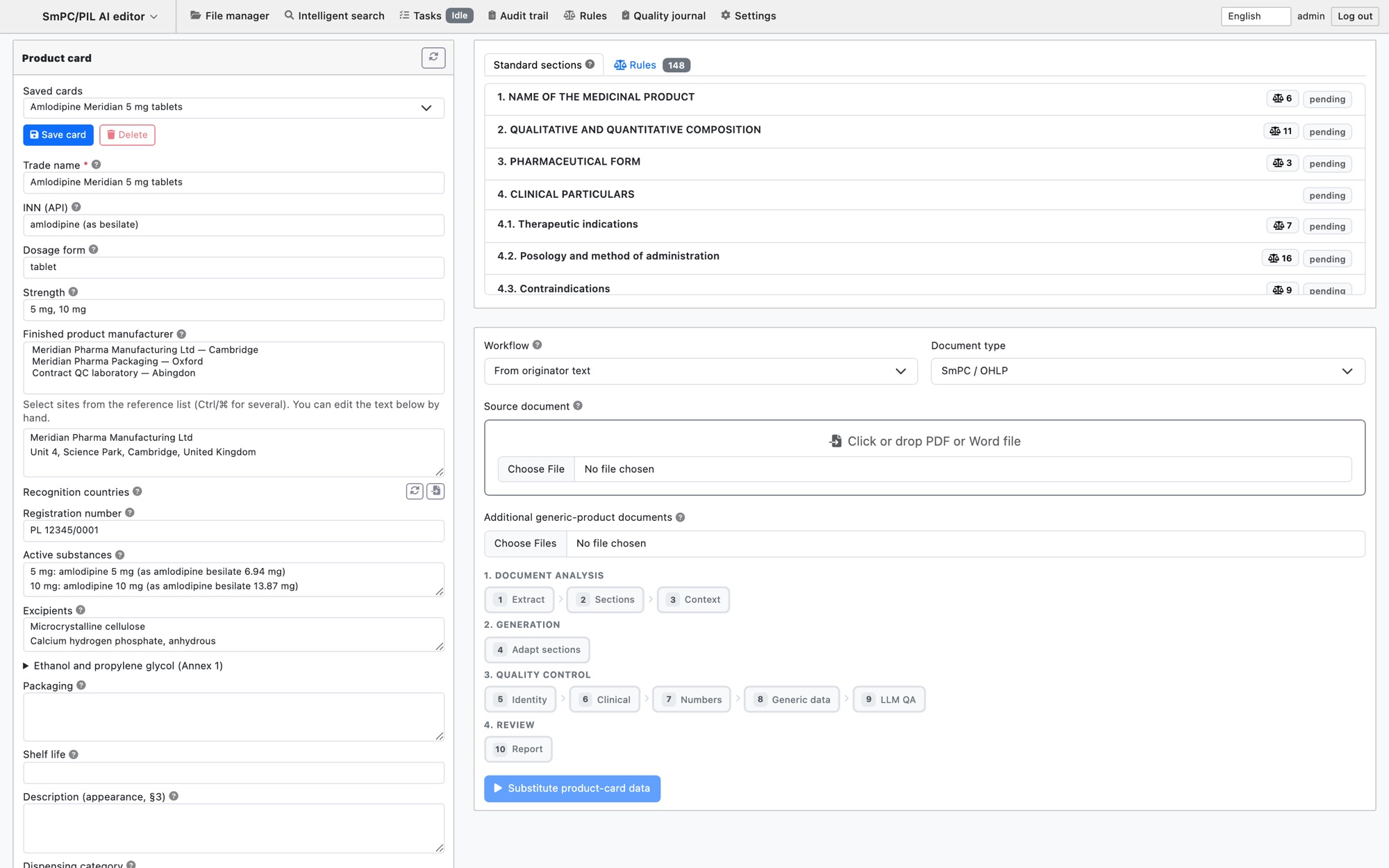
SmPC/PIL AI editor with the UK/MHRA rule set. Product data shown is a demo.
01 · The problem
A marketing authorisation dossier runs to hundreds of documents across five CTD modules, in several formats and often several languages. Highly qualified specialists spend much of their time sorting, cross-checking, reformatting and re-keying text rather than making regulatory judgements.
Generic and hybrid applications repeat the same work: adapting reference product information, filing documents into CTD sections, and checking that nothing is missing before submission.
A wrong strength in section 2, an excipient missing from 6.1, or a document filed in the wrong module leads to validation queries, requests for information and delays to market.
Since the UK left the EU, many products need parallel UK and EU documentation, and international filings add translation. SMEs and consultancies feel the capacity squeeze most.
Oxford Expert is not a general-purpose chatbot. Each module follows a defined regulatory workflow with published, auditable rules. The AI does the mechanical work, and decisions stay with the regulatory professional.
02 · Product
Each module works on its own and they share one knowledge base, one audit trail and one set of reference data. Teams can start with one process and add the others later.
Prepares the SmPC or patient leaflet for a generic or hybrid product from the reference product's text, and applies the rules of the target regulator.
Replaces: manual side-by-side editing of reference product information, line by line.
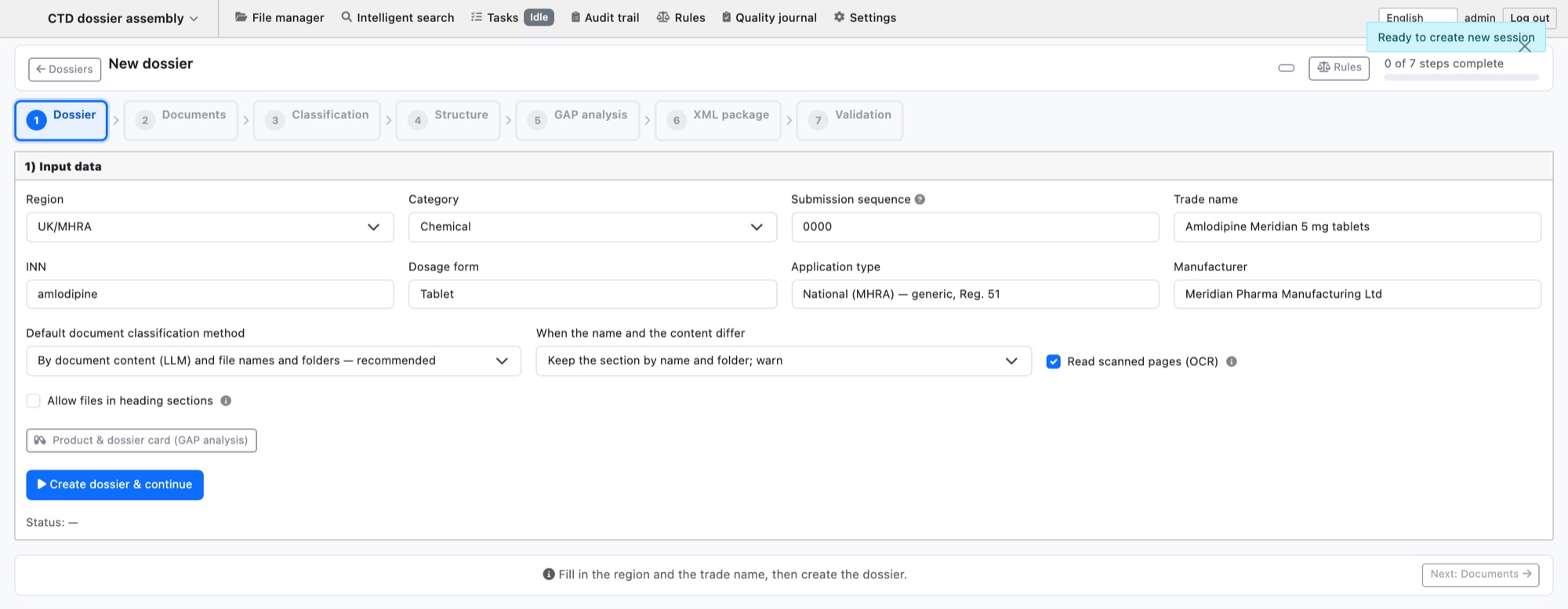
Turns a folder or ZIP of dossier documents into a structured CTD dossier and a submission package, in seven guided steps.
index.xml packageReplaces: days of filing, renaming and cross-referencing before publishing.
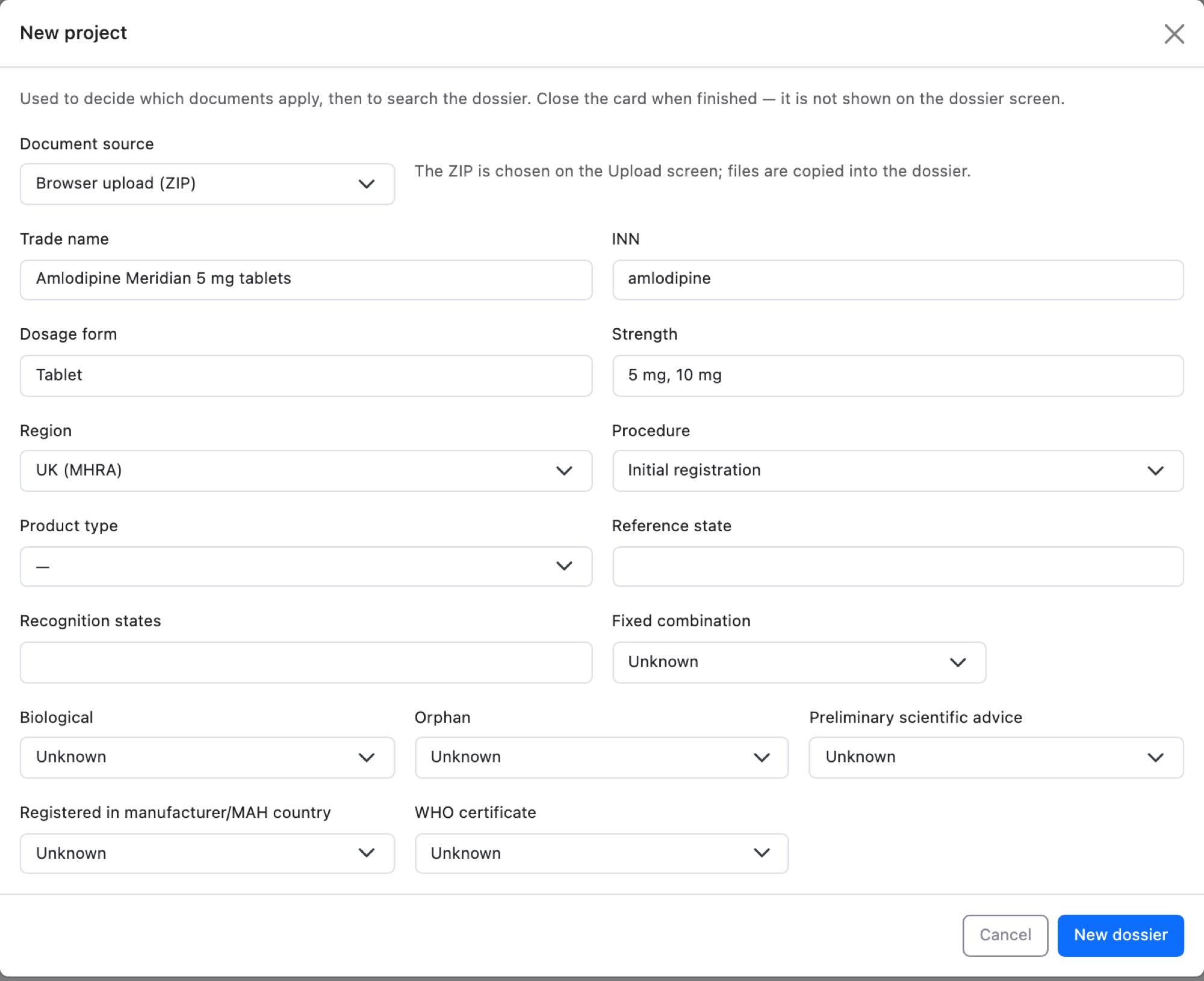
A pre-submission check that answers three questions: is everything there, is each document right, and do the documents agree with each other?
Replaces: manual checklists and validation queries discovered after submission.
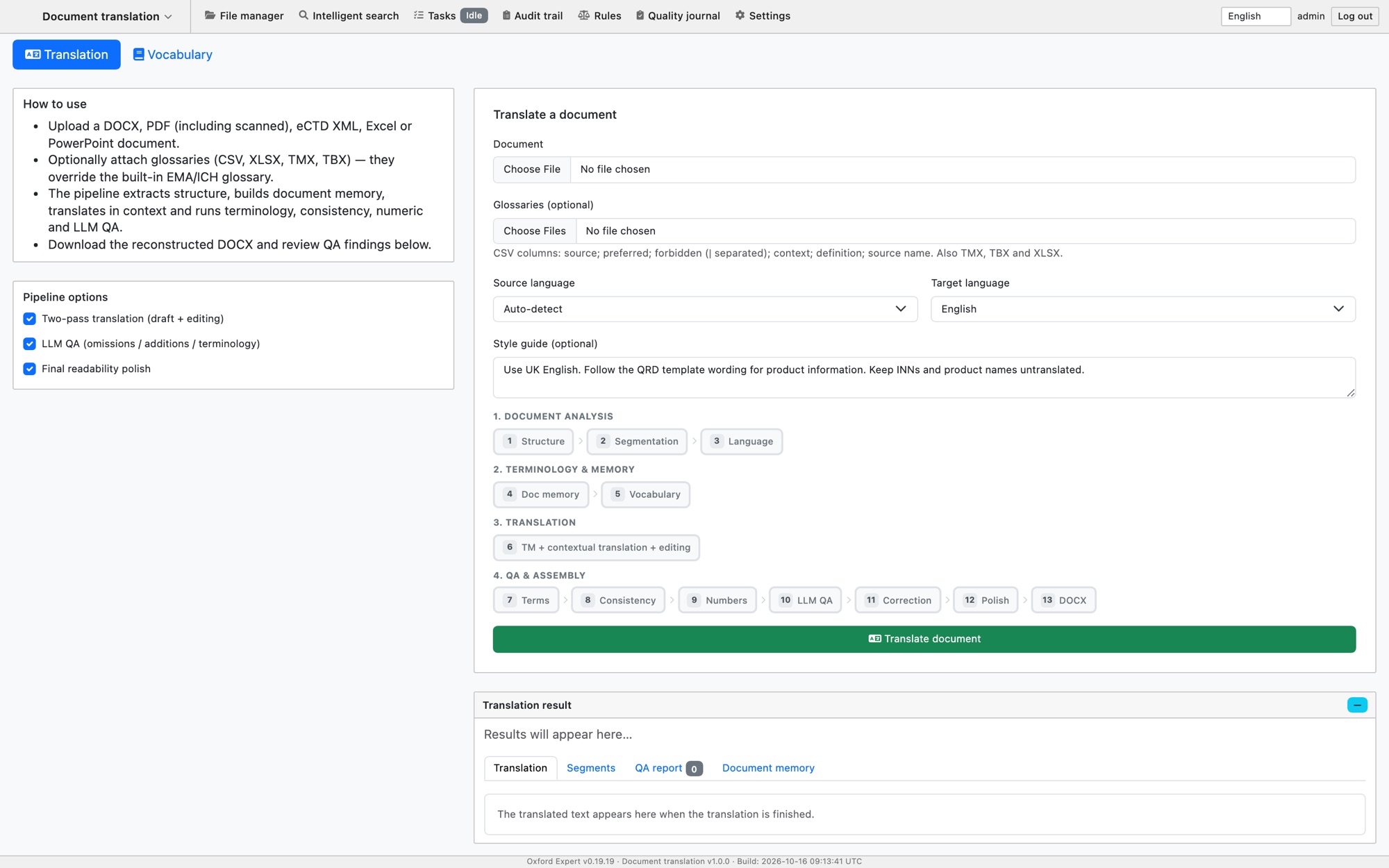
A regulatory translation pipeline that keeps terminology, numbers and document structure intact, and shows its quality checks.
Replaces: outsourced first drafts, and manual checks of numbers and terms in every table.
03 · How it works
The same pattern applies in every module. Nothing becomes a submission document until a qualified person has reviewed and accepted it.
Documents, a ZIP dossier or a reference SmPC. Scans are recognised automatically.
UserThe module classifies, drafts, checks or translates, following its published rule set.
Oxford ExpertFindings, open questions and tracked changes are presented for the specialist to accept or correct.
Regulatory expertWord, XML and Excel outputs, with an audit trail of who changed and approved what.
Oxford Expert + user04 · Business value
Change the figures to match your team. The time savings per item are working assumptions for discussion, and a pilot measures the real figures on your own documents.
An illustrative estimate, not a quote or a guarantee. Faster time to submission and fewer validation queries are not counted here.
Validate these figures in a pilot05 · Trust and compliance
In regulatory work an error is costly, so Oxford Expert is built around evidence, traceability and human control.
Drafts never become records on their own. Experts accept, edit or reject every change, and open questions are listed explicitly.
Actions, versions and approvals are logged. A quality journal records how module results were evaluated against test cases.
Every module publishes the rules it applies, with IDs and sources, exportable to Excel, Word or JSON for review by your QA team.
A dedicated instance per customer, on UK cloud hosting or on your own infrastructure. Processing follows UK GDPR, and customer documents are not used to train shared models.
The language model can be swapped. It can be a commercial API or a local, open-weight model, so confidential documents need never leave your network.
Designed with GxP computerised-system principles (GAMP 5, Annex 11) in mind. Documented requirements and test suites support your own validation.
06 · Working with us
Built for marketing authorisation holders, generic and specialty manufacturers, regulatory consultancies and CROs, from SME to enterprise.
Fixed scope, 6–8 weeks
Annual licence, per team
On-premise or private cloud
07 · Traction and roadmap
The four modules are built and running, and have been tested on real dossiers of more than 300 documents. Our next milestones focus on UK adoption, assurance and scale.
Regulatory teams ready to test a module on a live product.
Partners for Innovate UK and other collaborative R&D programmes.
Universities interested in Knowledge Transfer Partnerships on regulatory AI.
Who see regulatory AI as infrastructure for UK life sciences.
08 · Founder
Founder, Oxford Expert Limited · Oxford, United Kingdom
Anna is an analytical scientist with more than 20 years' experience in food, nutritional and pharmaceutical analysis. She works as a researcher in a proteomics and metabolomics laboratory and is an LC-MS/MS expert.
As compliance lead for food supplements at a nutrition institute, she has worked on regulatory compliance and the detection of undeclared pharmaceutical substances. That work showed her how much product quality and consumer safety depend on reliable, well-documented evidence.
Anna founded Oxford Expert Limited to bring that rigour to regulatory work. Its tools let specialists spend their time on scientific judgement instead of paperwork, and it offers professional education to build the skills to use them.
View LinkedIn profile09 · Questions
No. Oxford Expert drafts, classifies, checks and translates. Every output is presented to a qualified person, who accepts or corrects it, and where data is missing the system says so rather than guessing.
In a dedicated instance for your organisation, on UK cloud hosting or on your own infrastructure. Your documents are not used to train shared models.
The platform is model-agnostic. It works with commercial APIs and with locally hosted open-weight models, chosen to fit your confidentiality requirements and budget.
ICH CTD Modules 1–5, with target structures for UK/MHRA, EU/EMA, US/FDA and WHO, plus additional national formats. Product information rules cover UK/MHRA and the EU QRD template. Inputs include PDF (including scans), Word, Excel, PowerPoint and eCTD XML.
Typically 6–8 weeks for one module. You provide a representative product or dossier and a reviewer's time; we agree the success criteria with you and report the results in writing.
Yes. Modules take standard files in and produce standard Word, XML and Excel outputs. Enterprise deployments can integrate with document management and RIM systems.
10 · Next step
Tell us which process slows your team down most. We'll come back with a short demo and a pilot outline.